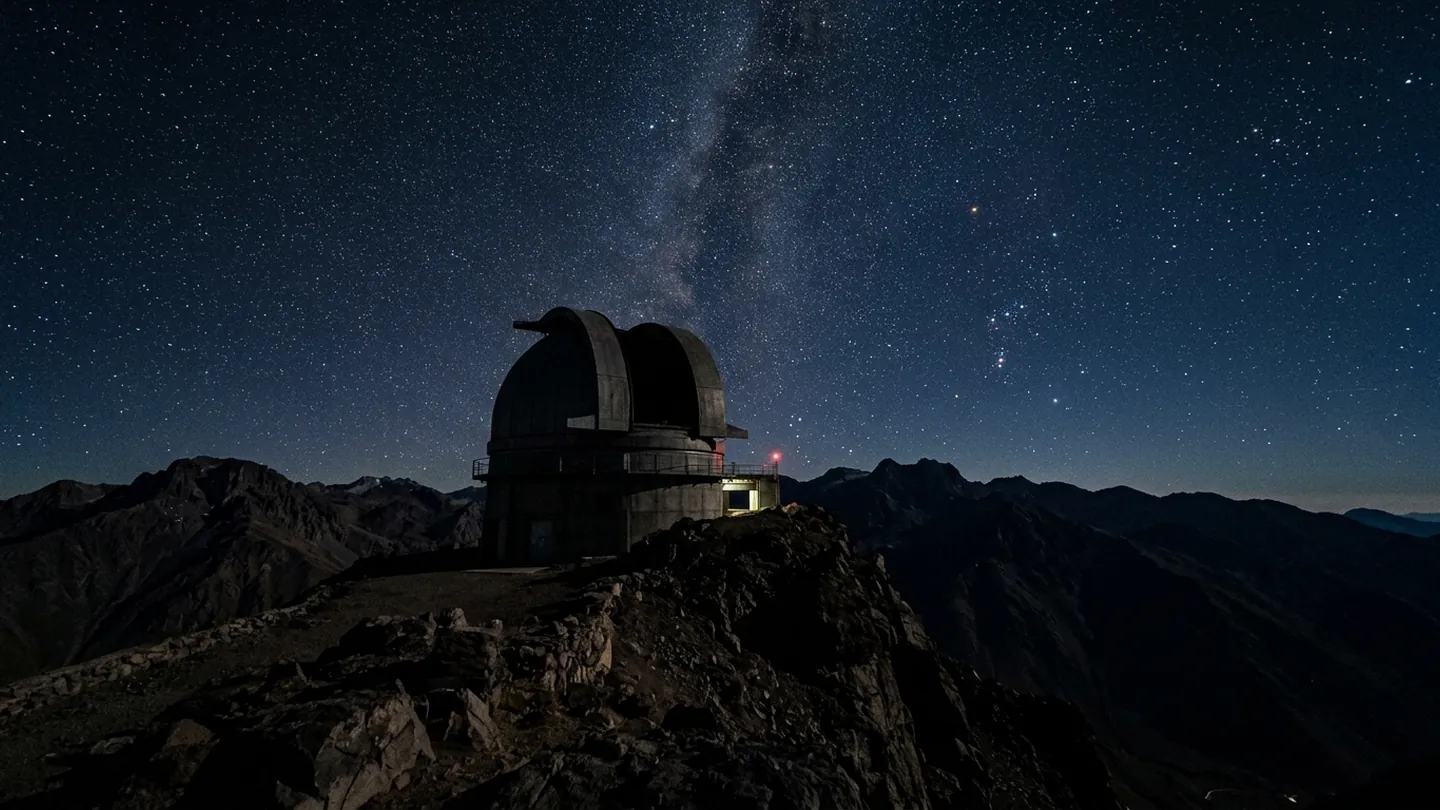
When a sub-Neptune planet crosses the face of a red dwarf star 110 light-years away, fewer than one in ten thousand stellar photons skims through the upper fifty kilometers of the planet's atmosphere before reaching mirrors in northern Chile. Yet within that hairline ring of filtered starlight, spectroscopists are now separating morning limb haze from evening cloud banks.
Resolving Doppler shifts from equatorial super-winds
Combining space-based infrared broadband curves with ground-based echelle spectrographs operating at resolving powers of R = 115,000 allows teams to measure subtle blueshifts and redshifts in methane and water absorption lines. On two warm sub-Neptunes cataloged this autumn, wind speeds along the day-night terminator clocked at 1.9 kilometers per second, lofting potassium chloride aerosols high above deeper water-vapor layers.
Calibrating detector stability to meters per second
Achieving that precision depends on laser frequency combs anchored in vacuum tanks whose temperature varies by less than a thousandth of a kelvin—precision optical engineering closely related to silicon photonic modulation and paired with long-baseline environmental monitoring like watershed sensor networks. Over the next three observing semesters, thirty-two temperate targets are queued for limb-asymmetry mapping.